


Choosing the right diesel generator is essential for maintaining uninterrupted power supply in homes, offices, commercial establishments, and industrial facilities. A generator that is too small may struggle with heavy loads, while an unnecessarily large generator can increase purchase and operating costs.
Understanding how to calculate generator kVA requirement helps you select a generator that can handle your electrical load reliably and efficiently.
In this guide, we will explain generator sizing, load calculation for diesel generators, factors affecting generator capacity, and important considerations for generator sizing for factories and industrial applications.
What Is Generator kVA?
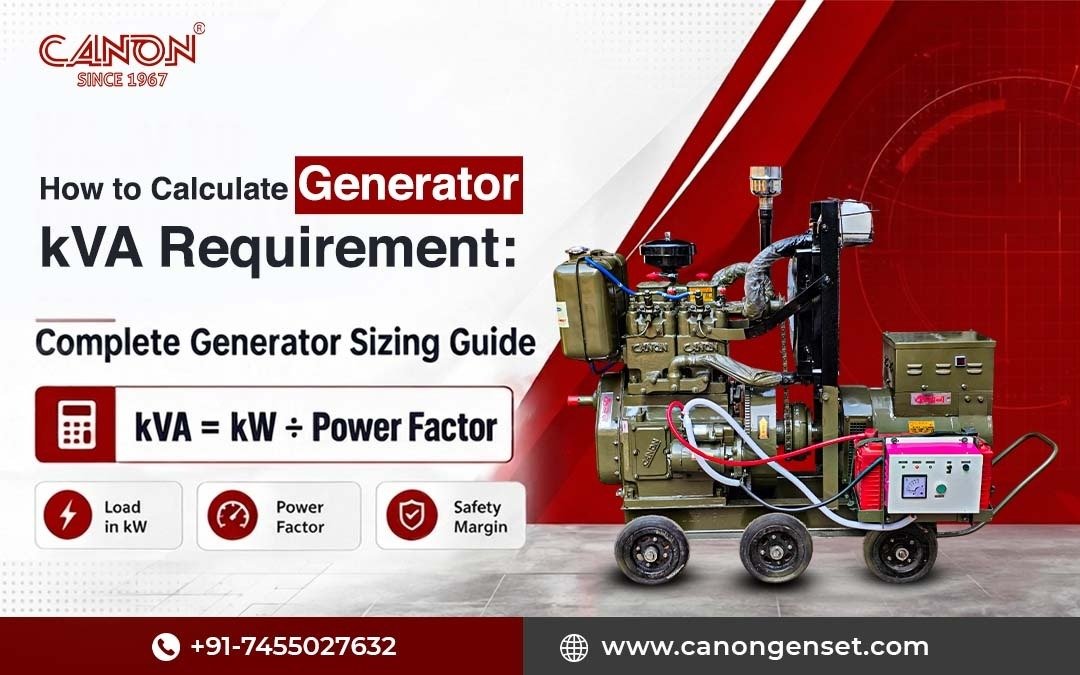
Generator capacity is commonly expressed in kVA (kilovolt-amperes). kVA represents the apparent power that a generator can supply.
The relationship between kW and kVA depends on the power factor.
Generator kVA Formula
kVA = kW ÷ Power Factor
For example, if the required load is 80 kW and the power factor is 0.8:
80 ÷ 0.8 = 100 kVA
Therefore, the calculated requirement is approximately 100 kVA.
However, this is only a basic calculation. Motor starting current, load characteristics, future expansion, operating conditions, and other electrical factors should also be considered before finalizing the generator capacity.
How to Calculate Generator kVA Requirement
The first step in generator sizing is understanding exactly what equipment needs backup power.
Make a list of all essential electrical loads, such as:
- Motors
- Pumps
- Compressors
- Air conditioners
- Fans
- Lighting
- Production machinery
- Refrigeration equipment
- Computers and servers
- Other essential electrical equipment
Step 1: Prepare a Load List
Record the rated power of every appliance or machine that may operate during a power outage.
For example:
| Equipment | Quantity | Load per Unit | Total Load |
| Motors | 3 | 10 kW | 30 kW |
| Air Conditioners | 2 | 5 kW | 10 kW |
| Lighting | — | — | 5 kW |
| Pumps | 1 | 5 kW | 5 kW |
| Other Loads | — | — | 10 kW |
| Total | 60 kW |
The total connected load in this example is 60 kW.
However, connected load and actual operating load are not always the same.
Step 2: Determine the Running Load
Not every machine necessarily operates at the same time.
For example, a factory may have 200 kW of connected equipment but only 150 kW operating simultaneously.
Therefore, generator selection should consider the maximum expected simultaneous running load, rather than simply adding every piece of equipment installed at the facility.
Identifying critical and non-critical loads can also help determine the actual backup requirement.
Step 3: Convert kW to kVA
Once the expected running load has been calculated, convert it into kVA.
For example:
Running Load = 150 kW
Power Factor = 0.8
Therefore:
Generator Requirement = 150 ÷ 0.8 = 187.5 kVA
The appropriate generator rating would then need to be evaluated based on the actual application, starting loads, operating conditions, and manufacturer’s recommendations.
Why Motor Starting Load Matters
One of the most important considerations in generator sizing is motor starting current.
Motors used in pumps, compressors, HVAC systems, production machinery, and other industrial equipment can draw considerably higher current during startup than during normal operation.
For example, a motor that consumes a certain amount of power during normal operation may require significantly higher electrical input for a short period when starting.
If a large motor starts while other equipment is already running, the generator must be capable of handling this temporary demand.
Therefore, when calculating generator capacity, consider:
- Largest motor connected to the generator
- Motor starting current
- Number of motors starting simultaneously
- Starting method
- Direct-on-line (DOL) starting
- Star-delta starting
- Soft starters
- Variable Frequency Drives (VFDs)
- Load sequencing
For facilities with large motors or complex machinery, professional electrical assessment is recommended.
How to Choose Generator Capacity
If you are wondering how to choose generator capacity, don’t base your decision only on the total wattage of your equipment.
Consider the following factors.
1. Total Running Load
Calculate the electrical load that is expected to operate simultaneously during a power failure.
2. Starting Requirements
Check whether motors, compressors, pumps, or other equipment have high starting currents.
3. Power Factor
Power factor affects the relationship between kW and kVA and should be considered during generator selection.
4. Critical Loads
Identify equipment that must remain operational during a power outage.
For example, a factory may need to keep production machinery, safety systems, servers, lighting, and essential pumps running while switching off non-essential loads.
5. Future Expansion
If you plan to add machinery or increase production capacity, the expected future load should be considered while planning the generator system.
6. Installation Conditions
Generator performance can be affected by factors such as:
- Ambient temperature
- Altitude
- Ventilation
- Installation location
- Cooling arrangements
- Exhaust arrangements
These factors should be evaluated for the actual installation site.
Generator Sizing for Factory Applications
Generator sizing for a factory requires greater attention because industrial facilities can have multiple high-power machines operating simultaneously.
A factory may use:
- CNC machines
- Motors
- Pumps
- Compressors
- Welding equipment
- HVAC systems
- Production machinery
- Material-handling equipment
- Lighting systems
Simply adding the nameplate ratings of all machines may not provide an accurate generator requirement.
A proper factory load assessment should consider:
Connected Load
The total rated capacity of all electrical equipment.
Maximum Demand
The maximum power expected to be consumed simultaneously.
Motor Starting Load
The additional demand created when motors and other equipment start.
Load Sequencing
The order in which equipment starts after generator power becomes available.
Critical Loads
Equipment that must remain operational during a power failure.
Future Load
Expected additional machinery or production capacity.
Diesel Generator Load Calculation Example
Consider a facility with the following estimated running loads:
| Load | Power Requirement |
| Production Machinery | 100 kW |
| HVAC | 30 kW |
| Pumps | 20 kW |
| Lighting | 10 kW |
| Essential Equipment | 15 kW |
| Total Running Load | 175 kW |
Assuming a power factor of 0.8:
kVA = 175 ÷ 0.8
kVA = 218.75 kVA
This gives a basic calculated requirement of approximately 219 kVA.
However, the final generator selection should not be made from this number alone. Starting requirements, operating conditions, load growth, and the generator manufacturer’s specifications should also be evaluated.
Common Generator Sizing Mistakes
Choosing the wrong generator capacity can result in operational and financial problems. Avoid these common mistakes:
Selecting a Generator Only on Connected Load
Connected load does not necessarily represent actual simultaneous demand.
Ignoring Motor Starting Current
Large motors can create temporary high electrical demand during startup.
Oversizing the Generator Without Reason
An unnecessarily large generator can increase initial investment and may not operate at an appropriate load level.
Ignoring Future Expansion
A generator selected only for today’s requirement may become insufficient if significant machinery is added later.
Forgetting Site Conditions
Temperature, altitude, ventilation, and installation conditions can influence generator performance.
Not Separating Critical and Non-Critical Loads
Running every electrical load during an outage may result in a significantly larger generator requirement than necessary.
Generator Sizing Checklist
Before purchasing a diesel generator, prepare the following information:
☑ Total connected load
☑ Expected simultaneous running load
☑ Power factor
☑ Largest motor rating
☑ Motor starting method
☑ Number of motors
☑ Critical equipment
☑ Required backup loads
☑ Future expansion requirements
☑ Installation location and conditions
This information can help a generator supplier or electrical professional determine the appropriate generator capacity for your application.
Why Proper Generator Sizing Is Important
Correct generator sizing helps ensure that the generator can handle the required electrical load while maintaining reliable performance.
An appropriately selected generator can help provide:
- Reliable backup power
- Better load management
- Stable operation
- Efficient utilization
- Reduced risk of overloading
- Better planning for future requirements
The objective should not simply be to select the largest generator available. The generator should be appropriately matched to the application’s electrical requirements.
Choose the Right Generator with Canon Genset
Selecting the right diesel generator requires more than a simple kW-to-kVA conversion. Running loads, motor starting requirements, power factor, critical equipment, future expansion, and site conditions should all be considered.
Canon Genset provides diesel generator solutions for residential, commercial, and industrial applications. With generator capacities available for different power requirements, the right solution can be selected according to your application’s specific needs.
If you are planning a generator installation for an office, commercial facility, manufacturing unit, or factory, share your load details and application requirements with the Canon Genset team for appropriate guidance.
Canon Genset – Trusted Power Solutions Since 1967.
Frequently Asked Questions
How do I calculate generator kVA requirement?
Calculate the expected running load in kW and divide it by the power factor.
Formula: kVA = kW ÷ Power Factor
Motor starting requirements and site conditions should also be considered before final selection.
How do I calculate load for a diesel generator?
Prepare a list of all equipment requiring backup power, calculate the expected simultaneous running load, consider power factor and starting loads, and then determine the appropriate generator capacity.
How do I choose generator capacity for a factory?
Factory generator sizing should consider connected load, maximum demand, motor starting current, production machinery, critical loads, load sequencing, site conditions, and future expansion.
Can I select a generator based only on kW?
kW alone is not sufficient for final generator selection because generator ratings are generally expressed in kVA and the power factor and starting characteristics of the loads also matter.
What happens if a generator is undersized?
An undersized generator may become overloaded when the connected load exceeds its rated capacity. High starting loads can also cause voltage or frequency disturbances.
Is a larger generator always better?
Not necessarily. Generator capacity should be appropriately matched to the actual application and operating requirements rather than selected solely on the basis of maximum available capacity.
Recent Comments